
Planning a trip beyond India's borders
often starts with one practical question: which countries will let you in
without a lengthy visa application from home. For Indian passport holders, the
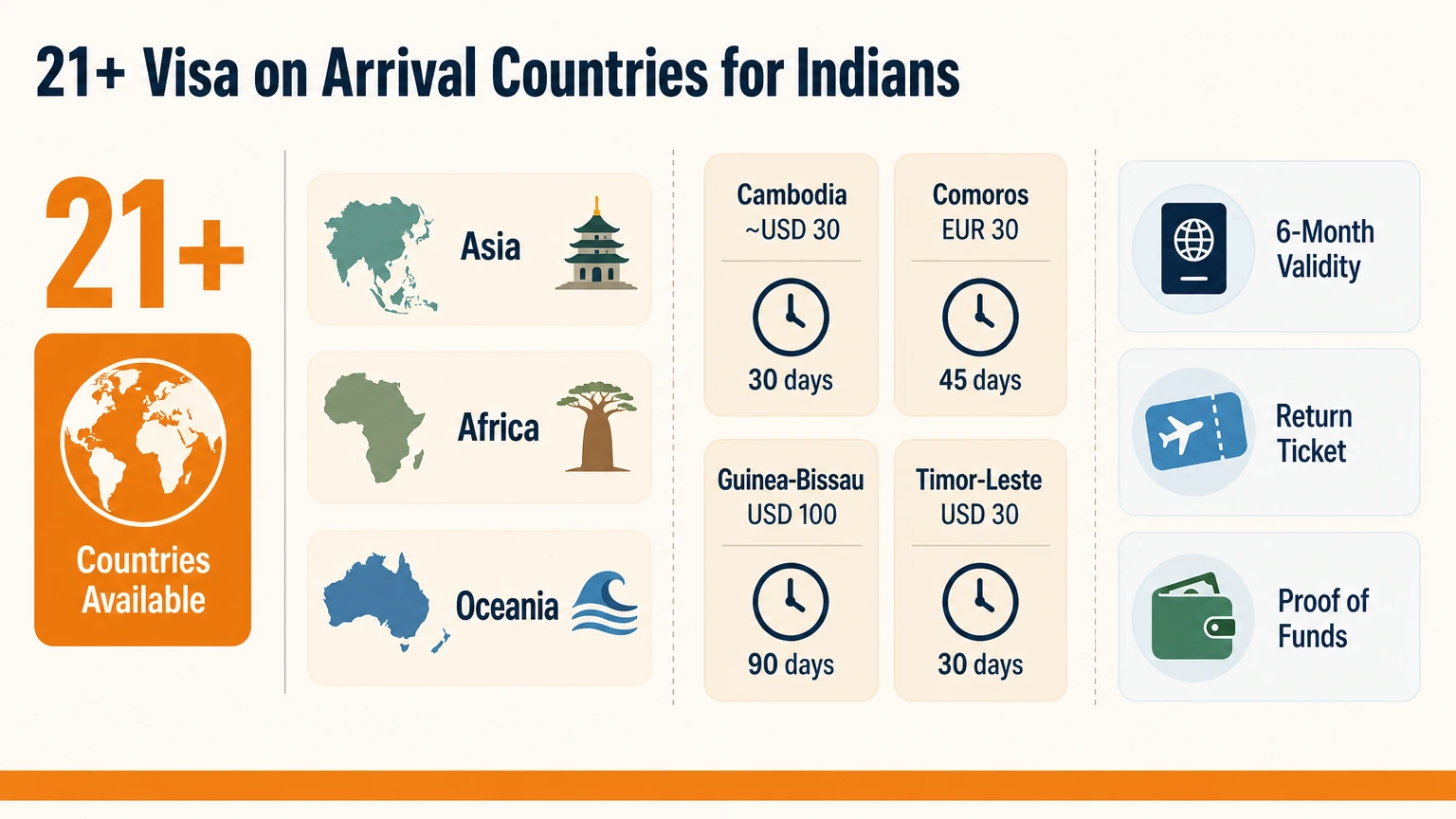
answer is encouraging. Over 21 countries across Asia, Africa, and Oceania
currently offer visa on arrival, letting travelers land, complete paperwork at
the airport, and start their trip within the hour.
This guide walks through exactly which
destinations grant visa on arrival to Indians in 2026, what each one costs, and
what documents immigration authorities expect you to carry. It also covers
recent policy shifts, since these rules change without much public notice.
Whether you are planning a beach holiday in
the Maldives or a longer overland trip through Southeast Asia, knowing the fee,
stay duration, and entry requirements in advance saves time and avoids the
stress of being questioned at the port of entry.
Key Takeaways
- Indian passport holders can access visa on arrival in 21+
countries across Asia, Africa, and Oceania.
- This guide breaks down fees, stay duration, and required
documents for each destination in one table.
- You will learn what happens if visa on arrival is refused at
the airport and how to handle it.
- Recent 2025-2026 policy changes affecting Indian travelers are
covered with specific updates.
- Practical guidance on paying visa fees, processing wait times, and traveling with minors is included.
What Is Visa on Arrival and How It Works for Indian
Passport Holders
Visa on arrival means the visa is issued at
the airport or land border itself, not before departure. An immigration officer
reviews your passport, collects the visa fee, and stamps you in in one process.
This differs from an e-visa, which is
approved online before you fly, and from visa-free entry, where no visa or fee
is needed at all. Indian passport holders should confirm which category
applies, since some countries listed as "visa on arrival" actually
require online pre-registration first.
Visa on Arrival vs. e-Visa vs. Visa-Free Entry
An e-visa is applied for and approved
digitally days before travel, giving certainty before you board. Visa on
arrival shifts that approval to the immigration checkpost itself, which is
faster but carries a small risk of refusal. Visa-free entry needs neither, though
passport validity and return ticket rules still apply.
Full List of Visa on Arrival Countries for Indians in 2026
The Ministry of External Affairs maintains
the most current government-verified list of visa on arrival countries for
Indians, updated regularly to reflect changes made by foreign immigration
services.
Popular Asian destinations include Cambodia, Thailand's neighboring
Indochina countries, Timor-Leste, and the Maldives, all offering short-term
tourist visas issued at the airport. Sri Lanka and Indonesia typically route
Indian travelers through an e-visa system rather than a pure arrival visa, so
checking the current mechanism before booking matters.
In Africa, Cabo Verde, Comoros, Ethiopia,
Guinea-Bissau, Tanzania, and Madagascar are among the countries granting visa
on arrival, each with its own fee and stay duration. Jordan also offers this
facility for tourists arriving by air.
Asia, Africa, and Oceania Destinations at a Glance
This spread of destinations means Indian
travelers have genuine flexibility for both short beach breaks and longer
cultural itineraries, provided each country's specific entry requirements are
met at the port of entry.
Comparison Table: Fees, Stay Duration, Currency, and
Documents Required
Fees, validity periods, and accepted
payment currencies vary considerably between countries, and the Ministry of
External Affairs does not publish a fee for every destination. The table below
summarizes verified figures where available.
|
Country |
Visa Fee |
Max Stay |
Key Documents |
|
Cambodia |
Not officially listed (commonly ~USD
30-35) |
1 month, extendable once |
Passport with 6-month validity, hotel
booking, return ticket, may need to show USD 500 cash |
|
Comoros |
EUR 30 |
45 days |
Proof of accommodation, return air ticket |
|
Guinea-Bissau |
USD 100 |
90 days |
Prior entry authorization recommended |
|
Timor-Leste |
USD 30 |
30 days, extendable once |
Passport with 6-month validity |
|
Ethiopia |
Not officially listed |
30 days |
Passport with 6-month validity,
applicable fee payment |
|
Cabo Verde |
Not listed; paid via EASE portal |
30 days |
Online pre-registration on EASE system |
|
Bahrain |
Not listed |
2 weeks or 3 months, by category |
Valid UAE, UK, USA, KSA, or Schengen
visa, or US Green Card |
Several countries require a qualifying
third-country visa or proof of funds rather than a straightforward
fee-and-stamp process. Confirming the exact requirement before departure
through Global Residence Index or official embassy channels avoids surprises at
immigration.
2025-2026 Policy Changes: Countries Added, Removed, or
Updated
Visa on arrival rules shift often, and 2026
has brought several updates worth flagging. Cabo Verde now requires online
pre-registration through its EASE system before travelers reach the airport
counter.
Cambodia's tourist visa on arrival remains
a single-entry, one-month facility, extendable once, though officials may ask
to see proof of funds, roughly USD 500 cash per passenger.
Ethiopia continues offering both an e-visa
and visa on arrival at Addis Ababa Bole Airport, each valid for 30 days, but
the government has not published a consolidated fee figure for Indian passport
holders as of August 2026.
Bahrain's facility stays conditional. Only
Indian nationals holding a valid UAE, UK, USA, Saudi (non-Hajj), or Schengen
visa, or a US Green Card, qualify for its visit visa on arrival.
Because these terms change without much
advance notice, the Ministry of External Affairs remains the most reliable
reference before booking any trip.
Documents and Entry Requirements You Must Carry
Every visa on arrival country expects a
consistent documentation set, even where fees or stay duration differ. Missing
paperwork remains the most common reason for delays at the port of entry.
Passport Validity, Proof of Funds, and Return Ticket Rules
Most destinations require at least six
months of remaining passport validity from the date of entry. A confirmed
return ticket is standard, and several countries request proof of
accommodation.
Cambodia and Bahrain sometimes ask
travelers to demonstrate proof of funds, either as cash on hand or a qualifying
third-country visa. Carrying printed copies alongside digital versions avoids
last-minute scrambling.
Paying Visa on Arrival Fees: Cash, Card, and UPI Considerations
Payment methods vary by country and even by
airport terminal, so relying solely on cards or UPI is risky. Guinea-Bissau
charges USD 100, payable in cash, while Comoros collects EUR 30 at the counter.
Cabo Verde's EASE portal takes payment
online before arrival, removing counter uncertainty. Carrying small
denomination US dollars or euros as backup for visa fee payment remains sound
practice across most African and Asian destinations.
How Long Does Visa on Arrival Processing Take at the
Airport
Processing speed depends heavily on how
many flights land simultaneously and how prepared each traveler is. A visa on
arrival application with complete documents typically clears within twenty to
forty minutes.
Incomplete paperwork, unclear return
tickets, or a lack of proof of accommodation can push this well past an hour.
Officers at some checkpoints may also request biometric data before stamping
the passport.
Traveling With Minors: Rules for Children Traveling Alone
or With One Parent
Families traveling with children need extra
documentation beyond the standard visa on arrival paperwork. Most destinations
expect proof that a minor is traveling with proper parental consent.
A notarized consent letter from the non-traveling
parent is standard when a child travels with only one parent. Children
traveling alone or with relatives typically need authorization from both
parents, plus copies of both parents' passports.
Immigration authorities at the port of
entry may ask further questions if a child's surname differs from the
accompanying adult's. Carrying birth certificates alongside consent letters
prevents unnecessary delays or, in rare cases, boarding denial at departure.
What Happens If Your Visa on Arrival Is Refused
Refusal at the immigration checkpost is
uncommon when documents are complete, but it happens, usually over an unclear
return ticket, insufficient proof of funds, or a passport nearing expiry.
Travelers denied entry are generally held
in a transit area rather than allowed past the port of entry. Officers document
the reason, and the airline that brought the traveler in often bears
responsibility for the return flight.
Appeal Process and Immediate Return Flight Logistics
Formal appeal options at the airport are
limited. Most countries do not offer on-the-spot reconsideration, so travelers
are typically rebooked on the next available flight home.
Keeping a printed itinerary, accommodation
proof, and embassy contact details on hand can speed up this process. A calm, cooperative response with officers
matters more than arguing the decision.
Why Travel Insurance Matters for Visa on Arrival Trips
Travel insurance is not always mandatory
for visa on arrival countries, but it protects against costs a rejected entry
or sudden illness can create abroad.
Some destinations that combine visa on
arrival with third-country visa requirements, such as Armenia, list travel
insurance among expected documents. Having a policy ready avoids last-minute
purchases at the airport counter.
Beyond Short Trips: When Frequent Travelers Consider
Long-Term Residency Options
Travelers who find themselves renewing
tourist visas or booking visa on arrival trips several times a year sometimes
reach a natural turning point.
At that stage, a residency or citizenship
by investment programme can offer more stability than repeated short stays,
particularly for business owners or families planning education abroad.
Those exploring options such as Portugal,
Greece, or the UAE typically benefit from working with an experienced advisor. Global Residence Index guides
clients through eligibility, documentation, and government review for these
long-term pathways.
Frequently Asked Questions on Visa on Arrival for Indians
Can Indians Get Visa on Arrival for Schengen Countries?
No. Schengen countries require a prior
tourist visa or e-visa application through their consulates. Indian passport
holders cannot obtain Schengen entry through visa on arrival at any port of
entry.
What Is the Henley Passport Index Ranking for India?
India's position on the Henley Passport
Index has shifted in recent rankings, reflecting changes in visa-free entry and
visa on arrival access negotiated with partner nations. Check current standings
before planning multi-country trips.
Overstaying, even briefly, can trigger fines, entry bans, or complications with future visa applications, so track your stay duration carefully at every destination.
