Diwali Explained: History, Meaning, Traditions and Celebrations
A complete, family-friendly guide to the Festival of Lights, including its many religious stories, the five days of Diwali, regional customs, food, children's activities and two interactive games.
1. What is Diwali and what does the name mean?
Diwali is one of the most widely celebrated festival seasons in India and among South Asian communities around the world. It is often called the Festival of Lights because homes, temples, gurdwaras, streets and public spaces may be illuminated with small lamps and decorative lights.
The name Diwali is related to the Sanskrit word Deepavali, commonly explained as a “row of lamps”. Deepa refers to a lamp or light, while avali means a row or series. Different Indian languages use different forms and pronunciations of the name.
Diwali is not one uniform celebration with precisely the same meaning for everybody. Hindu families may connect it with Rama, Krishna, Lakshmi, Kali, Vishnu or regional New Year traditions. Jains remember Mahavira's liberation, while Sikhs observe Bandi Chhor Divas during the same festival period.
2. Why do people celebrate Diwali?
Rama's return to Ayodhya
One of the best-known North Indian traditions comes from the Ramayana. Prince Rama, his wife Sita and his brother Lakshmana spent fourteen years in exile. After Sita was abducted by Ravana, Rama defeated Ravana with the help of Hanuman and his allies. In a cherished Diwali tradition, the people of Ayodhya welcomed Rama, Sita and Lakshmana home with lamps.
For devotees, the story expresses the restoration of rightful order and the triumph of dharma—a concept connected with duty, righteousness and the proper ordering of life. It is a sacred religious tradition rather than a modern event independently established by archaeology, and different retellings of the Ramayana exist.
Krishna and Narakasura
In several South Indian traditions, Deepavali is closely associated with Krishna's victory over Narakasura, a ruler described as oppressing others. Satyabhama has an important role in some versions. The story is connected with Naraka Chaturdashi and represents liberation from oppression and the restoration of justice.
Lakshmi and prosperity
Many Hindu households worship Lakshmi, the goddess associated with prosperity, good fortune and abundance. Homes are cleaned and decorated, lamps are arranged and a special space may be prepared for worship. Prosperity here need not mean simply becoming rich: it can include security, food, meaningful work, generosity, opportunity and family wellbeing.
Other sacred stories
Some communities emphasise Vishnu's Vamana avatar and King Bali, Govardhan Puja, Annakut, Kali Puja or a regional New Year. These are not merely alternative names for Rama's story; each has its own history and religious meaning.
3. The history and origins of Diwali
Asking for the exact year in which Diwali began makes a complicated history sound deceptively simple. The festival developed over a long period through religious narratives, seasonal observances, regional customs, worship practices, family traditions and changing social life.
Religious tradition and historical evidence
Sacred stories explain why communities understand a festival as holy. Historical study asks different questions: when descriptions appear in written sources, how customs changed, and what people observed in different regions. These approaches can inform one another, but they are not identical.
Seasonal connections
Diwali falls during the post-monsoon autumn period in much of India and has longstanding associations with household renewal, agricultural abundance, commerce and new beginnings. This helps explain the festival's vocabulary of prosperity and renewal, but it does not mean that every Diwali custom originated as a harvest ritual.
Over centuries, communities formed different observances around the same calendar period. Neighbours might share lamps and sweets while attaching distinct religious meanings to the occasion. Diwali is therefore better understood as a living festival season than as one event founded on a single date.
4. The five days of Diwali explained
Diwali is commonly described as a five-day festival. The pattern below is widely recognised, particularly in parts of northern and western India, but the timetable and importance of each day vary.
Day 1: Dhanteras
Associated with wellbeing and prosperity, including devotion to Dhanvantari and Lakshmi. Families may clean, prepare the home or buy useful household items. Purchasing gold is a custom in some communities, not a religious requirement.
Day 2: Naraka Chaturdashi
Also called Chhoti Diwali in some places and connected with Krishna's victory over Narakasura. In some South Indian homes, early morning bathing, prayers, new clothes and food make this the principal Deepavali celebration.
Day 3: Diwali and Lakshmi Puja
The main evening is associated with the new moon. Homes glow with diyas and lights; families pray, eat together and exchange sweets. Ganesh is often worshipped alongside Lakshmi.
Day 4: Govardhan Puja and Annakut
Observances include the story of Krishna lifting Mount Govardhan, food offerings known as Annakut, traditions concerning King Bali and, in Gujarat, the beginning of the New Year.
Day 5: Bhai Dooj
A celebration of sibling relationships, traditionally focusing on sisters and brothers. Related occasions include Bhai Tika in Nepal and Bhai Phonta in Bengal.
5. Diwali traditions and what they mean
Lighting diyas
Clay oil lamps may be placed at doors, windows, courtyards and shrines. For many Hindus the lamp is linked with auspiciousness, knowledge and divine blessing. Jain and Sikh communities attach their own meanings to festival lights.
Cleaning and decorating
Preparing the home creates a sense of renewal and welcome. In Lakshmi traditions, a clean and inviting home can form part of preparing for the goddess's blessings.
Rangoli and kolam
Decorative floor designs use coloured powders, rice flour, flowers or other materials. Rangoli and southern Indian kolam traditions have many local forms rather than one standard design.
New clothes, visits and sweets
People may dress for an important occasion, visit relatives, welcome neighbours, exchange gifts and share food. These customs maintain relationships across households and generations.
Giving
Sharing good fortune can include charity, food, hospitality and practical help. Children can learn that celebrating prosperity is also about generosity, not simply buying expensive things.
Interactive game 1: The Diwali knowledge challenge
Choose one answer for each question, then press Check my score. You can find every answer in this guide.
6. How Diwali is celebrated differently across India
India contains many languages, religious communities and regional traditions. The examples below describe broad patterns without claiming that every household in a region follows them.
North India
Rama's return to Ayodhya and Lakshmi worship are prominent in many communities, alongside lamps, family visits and sweets.
Tamil Nadu
Many celebrations begin early in the morning with an oil bath, new clothes, prayers and food. Krishna's victory over Narakasura is particularly significant.
West Bengal
The season is closely associated with Kali Puja in many Bengali Hindu communities, including temple worship, offerings and night-time illumination.
Gujarat
Diwali is closely connected with Bestu Varas, the Gujarati New Year. Some business traditions include opening or renewing account books.
Maharashtra
Observances can include Vasubaras, Dhanteras, Naraka Chaturdashi, Lakshmi Puja, Bali Pratipada and Bhau Beej, accompanied by lanterns, rangoli and homemade faral.
The essential lesson
Diwali is a collection of living traditions. One family's celebration should not be treated as a rule for every Indian family.
7. Is Diwali only a Hindu festival?
Hinduism
Hindu celebrations draw on multiple narratives and deities, including Rama, Krishna, Lakshmi, Vishnu and Kali. Worship, renewal, auspicious beginnings and family life may all be important.
Jainism
Jains associate Diwali with the nirvana of Mahavira, the twenty-fourth Tirthankara. Lamps may signify the continuation of spiritual knowledge. Prayer, temple visits and reflection can be central, while the principle of ahimsa—non-violence—may shape festive choices.
Sikhism and Bandi Chhor Divas
Sikhs commemorate Guru Hargobind's liberation from Gwalior Fort and the release of fifty-two other prisoners. The occasion centres on freedom, justice and care for others. It coincides with the Diwali period but has a specifically Sikh historical and religious meaning.
Buddhist participation
Some Buddhist communities in South Asia participate in Diwali or related festivals of light, but it is not a universal Buddhist festival. It is more accurate to name the community connected with a tradition than to combine every story into a single explanation.
8. Diwali around the world
Nepal: Tihar
Nepal's Tihar is a distinctive five-day festival of lights. Its observances include days honouring crows, dogs, cows and oxen, as well as Lakshmi worship, Mha Puja in the Newar community and Bhai Tika. It is related to the wider season but should not be described as identical to every Indian Diwali sequence.
United Kingdom
Families celebrate in homes, temples, gurdwaras, schools and public spaces. Leicester is especially well known for public festivities. British children may experience the festival at home, through school learning and at community events.
Other international communities
Diwali is celebrated in Mauritius, Fiji, Singapore, Malaysia, Trinidad and Tobago, Guyana, Canada, Australia, the United States and many other places. Customs reflect migration, local conditions and the ways families preserve connections across generations.
9. Traditional Diwali food and sweets
There is no universal Diwali menu. Recipes vary between regions, religions and households, and are often tied to family memory.
Ladoo
Round sweets made in many varieties using ingredients such as gram flour, semolina, flour, nuts, sugar and ghee.
Barfi and kaju katli
Dense sweets made with milk, nuts or coconut; kaju katli is cashew-based and commonly cut into diamonds.
Gulab jamun
Soft dumplings served in fragrant sugar syrup.
Gujiya and adhirasam
Gujiya is a filled festive pastry; adhirasam is a South Indian sweet commonly made with rice flour and jaggery.
Savoury food
Chakli, sev, namak para and chivda show that Diwali food is certainly not limited to sweets.
Family recipes
Preparing a familiar dish can connect children with parents, grandparents, places and languages.
Interactive game 2: Unscramble the Diwali words
Type the five festival words. Capital letters do not matter.
AYIDAILKMSHLAOGNIRMARAATHGIL10. How to explain Diwali to children
Explore the meaning of light
Use a diya or battery-operated candle to discuss what light does in a dark room. Then invite a child to name a kind action that could brighten somebody's day.
Tell a story with care
If the child's family follows the Rama tradition, use an age-appropriate Ramayana retelling and talk about homecoming, duty and courage. Explain that other communities tell different festival stories.
Make a family memory book
Ask parents and grandparents what they ate, wore and did during childhood Diwali celebrations. Children can write down the answers, add drawings and preserve a unique family history that a general textbook cannot provide.
Try a five-day kindness challenge
Children could tidy a shared space, thank a helper, share with a friend, make a greeting card and spend time with a sibling. These are optional learning activities, not replacements for religious observance.
Celebrate safely
Never leave children unattended near flames. Keep lamps away from loose clothing and paper decorations; consider battery lights for young children. Adults should follow local firework rules and safety advice. Families may also choose quiet, firework-free celebrations.
11. Common misconceptions about Diwali
“Every Hindu celebrates in exactly the same way.”
Hindu traditions are diverse. Families emphasise different deities, narratives, rituals and days.
“Diwali is Indian Christmas.”
The festivals may share food, family visits and gifts, but their religious histories and meanings are different.
“Diwali is the Hindu New Year everywhere.”
It marks a New Year in some communities, including many Gujarati households. Other Hindu calendars begin the year at other times.
“Fireworks are essential.”
They feature in many modern celebrations but are not required for every family's worship or festivities.
“Every Indian person celebrates Diwali.”
India includes numerous religions and traditions. Some celebrate religiously, some participate culturally and some do not celebrate.
“Diwali has one proven founding date.”
The festival evolved through different religious, regional and social traditions. One precise date would oversimplify that history.
12. Frequently asked questions about Diwali
When is Diwali in 2026?
The main Diwali celebration falls on Sunday, 8 November 2026. Dates and timings for individual observances can vary by place, calendar and community.
Why does the date change?
Traditional lunisolar calendars determine the festival. The main Hindu celebration is associated with the new moon during the autumn festival period, so the Gregorian date changes.
Why are diyas lit?
Diyas are linked with worship, auspiciousness and the imagery of light overcoming darkness. Their precise religious meaning varies.
Are Diwali and Deepavali different festivals?
No. They are names for the same broad festival, with Deepavali reflecting a Sanskrit-derived form. Languages and regions use different pronunciations and spellings.
Is Diwali religious or cultural?
It can be both. It has important religious meanings for Hindu, Jain and Sikh communities, while family and public cultural celebrations are also widespread.
Can a person who is not Hindu join a Diwali celebration?
Yes, when invited to a family or public event. Visitors should respect the host community's beliefs and distinguish cultural participation from worship.
What is the main message of Diwali?
Light, goodness, knowledge, hope and renewal are common themes, but the festival should not be reduced to one universal message shared identically by every tradition.
The meaning of Diwali: more than a Festival of Lights
A clay lamp glowing in darkness is a memorable image, but Diwali contains far more than one symbol. The season brings together worship, sacred stories, food, art, family relationships, local traditions and the memories of generations.
For children, it may begin with lights, sweets and clothes. As they grow, the festival can become a way to understand a family's beliefs and history. For people learning about India, it offers a window into the country's extraordinary diversity. A small lamp can hold an astonishing number of stories.
Continue exploring Diwali and Hinduism
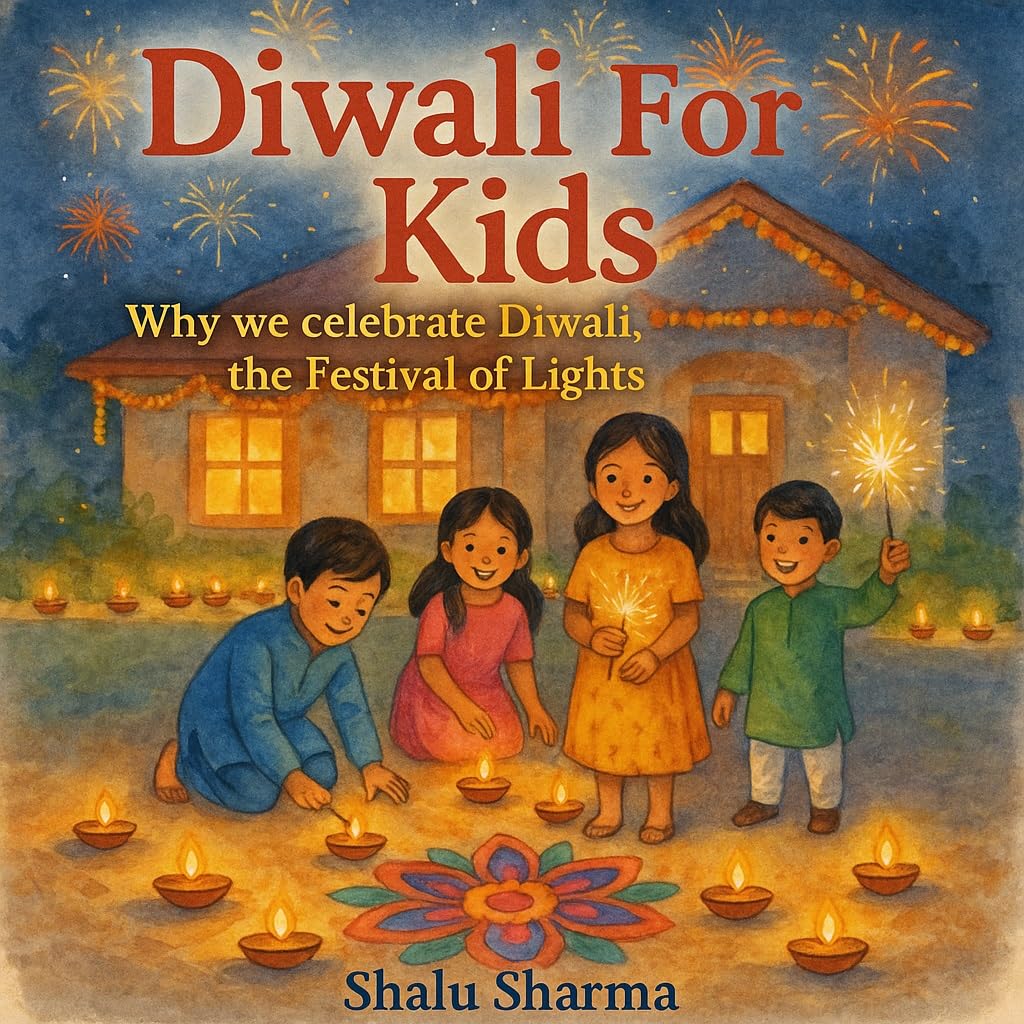
Diwali For Kids
Why We Celebrate Diwali, the Festival of Lights
A children's introduction to the stories, traditions and celebrations of Diwali. It is a gentle way for families to continue exploring the festival together after reading this guide.
Explore Diwali For Kids on Amazon →Hinduism Made Easy
Hindu Religion, Philosophy and Concepts
A wider introduction for readers who want to understand Hindu beliefs, ideas and terminology beyond the festival season.
Explore Hinduism Made Easy on Amazon →You can also visit the Shalu Sharma Amazon author page to discover more books.
Sources and further reading
This guide distinguishes between religious tradition, historical evidence and regional practice. External reference links below are marked nofollow.
