Please check out my book below: 👇: Namaste World. I am Diya. My life in India:

India for kids

My website now hosted with SiteGround

Initially when I started my travel blog it was hosted on HostGator on shared hosting plan. It went well like my other websites but one day, they sent me an email (this is about 3 years ago) that they had temporarily removed my website from their shared hosting as it was taking a lot of resources. They will put it back if I do a few things hence I must message them if I wanted the site up. I sent them a message asking them what I had to do get the website up and running. They messaged me back a few things that I had to remove a plugin and had to add a caching plugin. After I had done all that, my site was up.

Web Hosting

However I knew that I had to move my web hosting before I could do anything!

I contacted a few blogger friends and one of them was able add my website to her dedicated hosting. The hosting went well (for about 1.5 years) till a few weeks ago. She told me the site had grown and was not able to continue hosting my blog.

I then went into panic mode and looked for alternative hosting. I knew that it had to be minimum a Virtual Private Server (VPS) or at least a reseller.

I went on the web and searched and read website hosting reviews for hours and hours. I had helped a few of my friends set up their blogs. I had bought their hosting on eBay some of which was from the UK. I contacted the UK based company (which I had bought on eBay) and they were happy to give me a “managed” VPS for that included the following below.

4 CPU Cores
4 GB Ram 80GB
Diskspace 80GB
2000GB Bandwidth
and a fully managed cPanel

Web Hosting

The price looked appropriate and cheaper than the bigger names. They responded quickly to all my questions and I thought that I had found my hosting.

I went and bought it after giving it a thought for at least 1 week.

They migrated the site and everything looked alight for 10 days and then things went pear shaped.

The website was down for hours and when I contacted them many times they kept asking me what I was hosting on the website. They fact is that they could not handle the website. I kept getting emails in my inbox that they server was configured properly and had failed.

The final straw was when my website was down for one entire day and when I messaged the hosting company, they had no idea what was going on and they rebooted the server. That didn’t bring the site up…

I have grudges against this company. In fact, I have a couple of small websites hosted on their servers.  They staff had been appropriately responded to my questions, it’s just that they were not able to host my website which they didn’t want to admit.

I knew that it was time for me to find another web hosting company. Someone from Facebook ground recommended SiteGround.

I then spent an hour reading their website, SiteGround hosting reviews and comparisons. For example this one, Siteground vs Hostgator. A lot of people had written good reviews about them.

I talked to one of their staff via their chat. They told me the kind of hosting was needed and was assured that the site would be migrated to their hosting.

I then bought the WordPress hosting plan (their higher plan). I didn’t even have to send them the ticket. As soon as I signed up, there was a question asking me if I needed to transfer anything to their servers. If yes then I should complete a form which I did straight away.

Funny thing is that the previous hosting sever was down and I had no access to the cPanel. Luckily I had a copy of the complete backup. I sent SiteGound the copy.

Guess what…

After competition of the website migration form, I got a message from SiteGound in about 30 minutes that the website had been transferred and all I had to do was change the Domain Name Servers (DNS).

Which I did ASAP…

I checked after 4 hours later and the site was up…

SiteGround WordPress hosting review

SiteGround WordPress Review

Let’s take a look at what SiteGround actually offers…

Geeky SuperCacher- their own cacher plugin rather than the usual ones making your website faster.

Free Cloudflare CDN makes your website load faster in any part of the world by caching its content and distributing it over multiple data centers. When foreign visitors access your website, our CDN delivers the content much faster from the data center closest to them.

And a host of other things and support…!!

So all in all, I have am very satirised with SiteGround. I highly recommend considering their services if you have a travel WordPress website and want to save yourself a agony. Click here to find out more about SiteGround.
Why animal lovers should avoid visiting India

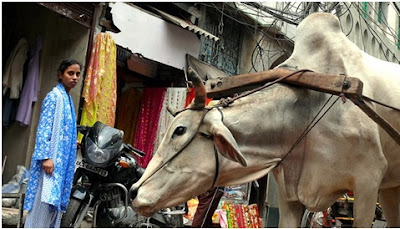
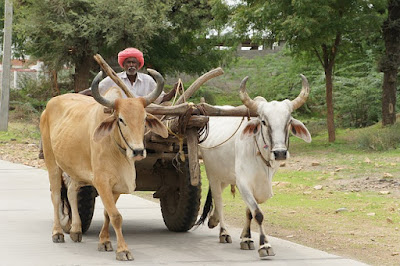
If you are an animal lover then it might be best you avoided India altogether because some of the things you might see on the Indian roads will break your heart. I want to point out to some of the atrocities inflicted on the ox. If you are travelling to the rural areas of India, you are bound to encounter the ox cart (called bullock-cart in India) used mainly for agricultural purposes. It’s not just the farmers who use these animals; it’s used extensively in urban areas too mainly for transportation.


The ox is much sought and prized animal in India to do the things exactly as seen in the photos. In the cities, it is used for transportation, while in the rural area it is used to plough the land not to mention that it is a source of cattle dung for fuel.

The reasons for the survival of the ox cart in India is due to the fact that many farmers in India are poor and it does not require hard-to-get petroleum based high-priced fuels and the lack of decent roads in many areas of rural India. I remember my grandfathers’ village in Monger district of Bihar state it still does not have paved roads. You need an SUV (we call it jeep in India) to get there or one of these bullock carts.

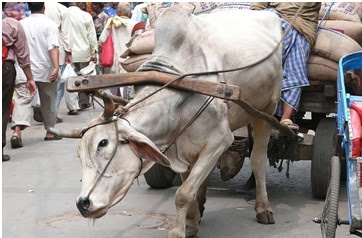
These oxen have to go through a lot. Take a look at this photo, where the load is lighter, the ox may look a little skinny but seems to be fine but unfortunately in the second photo, it really breaks the heart.


The trouble is that the life of an Indian labourer is sadly not much different to an animal either. If the sweltering heat, or the congested streets, narrow lanes, wandering cows, crowded bazaars, cycle rickshaws or Indian traffic does not slap you in the face than scenes like these will certainly hit you hard almost like a full smack in the face. Try to stumble into any back alley or street in any Indian town and you’ll soon stumble into an India of grinding hard work. The old man seen in the picture pulling below seems to be struggling.

The brutality inflicted on these animals causes disease especially cancer of the neck that significantly reduces their life span then they end up in the slaughter houses.

Just as the horse wagons in America were eliminated in the USA, don’t you just wish that these carts too were eliminated from India?

It’s not a pretty site. This abuse of bullocks is in direct violation of the Prevention of Cruelty to Animals Act, 1960. But no one cares in this country. There are no human rights to speak off let alone animal rights. The only thing some people care about is protecting the cow and preventing people from eating beef.

I wonder how many of these animals are often deprived of food and water too?

Kanchipuram – City of Temples

Kanchipuram is also known by the names Conjeeveram, Kanjeevaram and Kanchi is a small town situated at a distance of 75 km from Chennai in Tamil Nadu. Kanchipuram is famous for the cotton and silk industry and imposing centuries old temples which has earned it fame as Varanasi of South India.  It is one of seven major pilgrimage centres for Hindus believed to give salvation to the devotees who visit them and worship the deities in the numerous temples of the city. At one time the city was known to be an abode of more than 1000 temples, but at present more than 100 have survived including some amazing churches and mosques.

The city had earned its importance as the capital of Pallava’s from 4th-10th century. Gradually the town became a learning center which was visited by Buddhists, Jains and Saivite Hindus; though today the Jain and Buddhist temples have become extinct, leaving only archaeological remains behind.

Kanchipuram Silk Sarees

Kanchipuram is known for its unique silk and cotton saris which are hand woven by weavers who have learned the trade from their ancestors who settled here nearly 400 years ago. Kanchipuram silk and cotton saris is ranked among the best in India, which has also got it the name as ‘Silk City of India’. The handloom saris are often woven by the threads of pure silk in vivid vibrant colors; in addition they are decorated with bright gold and silver threads called zari.  Everyday thousands of competent and talented weavers work on handlooms, producing dazzling silk saris that are sought by people for weddings and special occasions.

The raw materials for production is imported from different towns, as the occupation is only to weave the sari’s, therefore they are not involved in cultivation or production of silk threads.  Three single pure mulberry silk threads are entwined to form the threads of Kanchipuram silk which gives it’s attractive texture, with lustrous look and finish, in addition to being very durable if certain maintenance rules are followed.

The designs are created by the zari which is produced by interweaving silk, silver and gold threads. When combined with vibrant colors of every hue, the amazing decorations fashioned with the zari create designs that leave people spell bound. Though expensive, the famed sari’s last long enough that at times they are known to passed down to generations. Here’s how to wear sarees.

Kanchipuram Temples

Ekambareswarar Temple

The 11 storey Shiva Temple is one of tallest temples, which spreads over 20 acres of land while its tall southern tower soars to a height of 58.5m. Devotees throng to worship the Linga in the temple throughout the year. One of the most amazing attractions of the place is an ancient mango tree which bears four different leaves and also four different varieties of mangoes though it shares the same bough. The four branches are known to represent four Vedas.

Kailashnath Temple

This temple is also dedicated to Lord Shiva. Build in limestone, the temple is abode to amazing art of Fresco style paintings and sculptures which has been well preserved even to this day. The temple is situated far from the busy commotion of the city, other than the day of Shivaratri when devotes have to wait in long queues to just get a glimpse of the deity.

Sri Kamakshi Amman Temple

This temple is dedicated to goddess Shakti which is one of three important temples of the goddess in India. The temple is also famous for its golden tower and chariot.

List of other important temples in Kanchipuram

  • Vardaraja Perumal Temple
  • Ulagalandar Temple
  • Vaikunta Perumal Temple
  • Kacchapaeswarar Temple
  • Vijayaraghava Perumal Temple
  • Jain Temples at Tirupparuthikkundram
  • Subramaniya Swami Temple]

Around Kanchipuram

For those who have time to look around, apart from Chennai, there is Mammalapuram, which is host to art of Pallavas, Muttukkadu lake which has facilities for boating and wind surfing, Covelong beach which is excellent place to enjoy good swim along with wind surfing. It has a good resort for stay. The place is also famous for an ancient Dargah and church. Situated at the distance of 48 km from Kanchipuram, the water bird sanctuary is visited by birds like storks, flamingos, pelicans, cormorants, kingfishers, swans and many other birds which are not commonly sighted in India. The best time to visit is during October to March, when many migrant birds can be seen.

Getting There

The nearest airport and major city is the capital of Tamil Nadu, Chennai, which is well connected to Kanchipuram by well maintained roads. The town also has a railway station, so that those interested to travel by train can opt for it. You can get around the town walking small distances, or hiring an auto rickshaw or Taxi for convenience.

Tourist Indian e visa application process

One of the quickest ways to get a visa for India is to apply for an e-tourist visa (electronic tourist visa). You do not need any travel agent and you can do this yourself. All you need to do is apply for the e visa online and wait for it to come via email. The idea is simple; you apply for an electronic visa for India online, print out the application form, post it, the Indian consulate will email you the Indian e-visa, you print it out and hand it at the desk on arrival in India. It can take as little as 1 day to a maximum to 4 days (Monday to Friday) and you can stay 30 days from the date of arrival. It’s valid for a single entry.

It’s not like the traditional visa where it is stamped to your passport. You need to hand this to the immigration desk when you land in India. When you arrive in India the immigration desk will stamp your passport. This is a single entry visa. If you need to apply for multiple entries then you will have to apply on the same website but need to present or send your passport for stamping. However in the January of 2016 it was announced that the multiple entries will also become available and e tourist visa holders will receive a gift pack on arrival to India (you will find out the options when you start applying). But I do not think it has been implemented yet.  

If you are a citizen of the UK or the USA then you can apply for the Indian tourist e-visa. 149 other countries have also been added to the list eligible to apply for the Indian e-Tourist visa. This visa allows tourists to enter India through 16 international airports namely Ahmedabad, Amritsar, Bengaluru (Bangalore), Chennai (Madras), Cochin, Delhi, Gaya, Goa, Hyderabad, Jaipur, Kolkata (Calcutta), Lucknow, Mumbai, Tiruchirapalli, Trivandrum and Varanasi.

tourist e visa india

The Government of India visa website does specify certain criteria and if you do it currently it will take only a few days to get your e-visa. Basically you should not apply for the e-visa no later than 4 days prior to going to India and 34 days before the date of arrival in India. You can apply for e visa 2 times in 1 calendar year.

In a nutshell e-visas are for tourists visiting India for recreational purposes, short visits like visiting relatives, business or medical treatment etc. Your passport should be valid for at least 6 moths and you should have already bought your tickets and should have enough money to spend in India.

Step to step guide to getting e visa for India:

Complete the e visa application form here

Upload your photo and a copy of your passport (this means you will need a printer and scanner. You can either take your passport to place where they will scan your passport and email it to you or simply you can buy a printer and scanner)

You can then pay your e-visa fees

Don’t forget to insert your email address as your e tourist visa for India will be sent to your email

Wait for your e visa to arrive (don’t forget to check your spam folders)

Print it out and take it to India.

Tourist Indian e visa application
Tourist Indian e visa application process

Notes:

E visa India contact number and email address

Your Indian high commissions or consulates do not have control over Indian e-tourists visas so if you need to ask them anything about these visas they wouldn’t know. If you need any clarification or if any doubt, then you will need to send an email to indiatvoa@gov.in or you can phone them on this number +91-11-24300666.

e visa photo requirements

The e visa India photo size is not the usual passport size photos. 


It should be 2 x 2 inch (50 x 50 mm). The background should be plain. The chin to crown (basically the entire head) should cover 1 to 1-3/8 inches (25 to 35 mm).

Must in JPEG format and size of Image should be minimum 10 KB and maximum 300 KB
You can check your parameters of your image by right clicking on the photo and then clicking properties. If you photo is big you can downsize the image by reducing the size.

Basically it’s a square photo. Many photo booths in superstores are now able to provide these Indian visa photos. If you can’t find a one then you will need to go to a photo studio.

But make sure that the background is white or plain; your head must be in the centre, there should no borders, eyes open, no smiling and no shadows.

e tourist visa cost

Fees for the e tourist visa are around 40 pounds if you apply from the UK and 60 dollars from the USA per passenger. It’s a very cost effective way of applying. It saves you going anywhere (consulate, embassy or even the India visa and consular service application centre called the VSF).

You will need to present return tickets on arrival in India along with your e tourist visa that you received though email so make sure you print a few copies of your e visa.

Rishikesh: The birthplace of Yoga in India

Located in the foothills of the Himalayas, in the northern state of Uttarkhand, Rishikesh is the birthplace of Yoga and therefore, the perfect place for those looking for the peace of mind, body-soul balance and self-discovery. But it is also the place for adventurers and adrenaline seekers. The holy City has plenty to offer and charm different kinds of travelers, and is one of the most visited places in the North of India.

But Rishikesh not only refers to the main town, it also includes the settlements along the banks of the Holy River Ganges –and where you’ll probably spend most of the time-; Muni-ke-Reti, Shivananda Nagar, Ram Jhula and Lakshman Jhula, home of many popular Ashrams (such as Sivananda, Divine Life Society and Parmath Niketan), temples, Yoga studios and DELICIOUS cafes offering vegetarian meals. Oh yes! By law, this is a Vegetarian City and unlike other ‘party places’ in the Himalayas (A.K.A Manali and Kasol), you shouldn’t expect to find alcohol either; although weed is allowed and consumed openly.

Wise Advice: If you are planning to stay at one of the Ashrams, check out if there is any upcoming festivals and try to book your place in advance! Rishikesh is a very popular destination for tourists and backpackers and the place can be packed pretty soon. But don’t worry too much..! Ram Jhula and Lakshman Jhula are full of hostels and guest houses from as low as 200 Rs per night! Also, be careful during the Monsoon season (July to August); the heavy rain may lead to serious flooding and the Rafting is also restricted during those months.

Spiritual Journal: 101 Spiritual Questions to Ask Yourself: Spiritual Awakening

Places to visit in Rishikesh…

Temples

There are lots of them around, but here are two that I advice you not to miss: the Tera Manzil and Bootnath Temple. The first one is located in Lakshman Jhula and has 13 floors of little rooms to worship different gods and goddess, as well as shops to buy souvenirs and religious articles. But if you wanna appreciate Rishikesh in all its glory, get ready for a little walk from Ram Jhula and climb up the 11 floors. I promise you WON’T be disappointed!

Ganga Aarti in Rishikesh

This beautiful ritual is one of the most popular activities amongst visitors and is performed at dusk in the three major holy cities of Rishikesh, Haridwar and Varanasi at the banks of the Holy Ganga River. Here is held at the Parmath Niketan Ashram,. The religious ritual consists in prayers, chantings and the reading of Vedas by the Gurus and their students. For me, it was a deep and renovating experience.

HINDUISM: Hinduism for Beginners: Guide to Understanding Hinduism and the Hindu Religion, Beliefs, Customs, Rituals, Gods, Mantras and Converting to Hinduism

Ganga Aarti in Rishikesh

The Beatles Ashram

We were walking around Ram Jhula when we saw a board indicating the way to ‘The Beatles Ashram’ (say whaaat?!!!) and although somebody else had told us about it, we were not expecting to find something like that. In the middle of nowhere! The place was built by the Maharashi Mahesh Yogi, worldwide famous for his Transcendental Meditation methods and seminars all around the globe. Well, it was exactly in one of those where he met The Beatles in 1967 and the guys were so impressed that decided to join him the next year in an intensive course in Rishikesh. The time they spent there is supposed to be one of the most productive periods for the band, and most of the songs they wrote there were recorded in The White Album and Abbey Road.

Despite the fame and glory of the Ashram and its famous visitors (musician, actors and politicians) the place was closed in 1981 and now belongs to the Administration since is located in the lands of the Rajajai National Park. And that’s exactly what makes the place even more interesting; like a huge ghost of stone and bungalows in ruins, beautifully blended with the nature. The main gate is closed and the entrance is ‘prohibited’, but you’ll find a huge hole in the side and run into lots of travelers armed with cameras to capture the beauty of the legendary place. DON’T MISS IT when you go!

Adventure Sports

Trekking, Camping, Rock Climbing, Bungee Jumping and Water Rafting in Rishikesh are the most popular –but not only- activities for the adrenaline junkies. On our trip, my boyfriend and I tried Water Rafting and it was pretty cool! For those used to extreme experiences in the water, it may not be enough since the ride is smooth and not too wavy, but for me (beginner and absolutely terrified of water, strong currents and rocks together) it was the perfect dose of excitement. These activities are not hard to find and not too expensive either. We did a 12 Kilometers ride in 800 Rs per person.

rishikesh water rafting
Water rafting in Rishikesh

Rishikesh YOGA Retreat

Ahrams, Yoga Studios and personal teachers offer their services all over town; you can go for a 300 to 500 Rs class or take one of the free lessons offered by some places. We attended a drop-in class at Shri Sant Sewa Ashram and gave a small donation at the end and it was pretty great!

Where to EAT in Rishikesh

With all the walking/rafting/trekking and yoga practice, you may need to refuel a couple of times a day, but that’s not really a problem here! Not either the fact that this is vegetarian city and most of the places don’t even use eggs!!… And well, for this Southamerican girl -we eat LOTS of meat down there- that was one of the most impressive things since the food is SO G-O-O-D! and so diverse too; there are lots of ‘German Bakeries’ and ‘Confectioneries’ all over the area; the one in Devraj Coffee Corner crossing the Lakshman Jhula bridge from the Tera Manzil Temple is to die for! So make sure you don’t miss the delicious Strudels, Apple Pies, Cinnamon Rolls, brownies and the endless list of Indian delicacies, although their Italian dishes are also a must try.

Laxman Jhula
Laxman Jhula

The Indisputably winner, highly recommended by every visitor to Rishikesh should visit is the Little Budhha in Lakshman Jhula; the environment and beautiful view to the Ganges make it an amazing place to chill for hours, but is the delicious food with Indian, Mexican and Israeli options what will make you come back.


Stonehenge Facts

Are you a spiritual person? Do you like visiting spiritual places? If yes then you will definitely like Stonehenge! In Wiltshire, England, there is a prehistoric monument known as Stonehenge which attracts millions of visitors from around the world each year.

Surprising Stonehenge Facts

Stonehenge is basically made up of large standing stones that are aligned in a ring on a grassy landscape. Archaeologists believe these stones were aligned sometime during the Bronze Age or Neolithic Age, which would be around 3,000 B.C. and 2,000 B.C. Stonehenge is situated within artificially changed levels of land called earthworks. There are also hundreds of burial mounds in this area. This has archaeologists and historians believing that Stonehenge was probably a burial site before the stones were erected. This was proven to be true after the bank and ditch of the land had been dug into for the first time. Diggers found human bone deposits in the soil that were dated as being from 3,000 B.C. It is believed the land was used as a burial ground for at least five hundred years before it became a monumental site with standing stones on it. This archaeological evidence was discovered in 2008 and it has changed how scientists view the early days of the Stonehenge and the land which surrounds it.

Spiritual Journal: 101 Spiritual Questions to Ask Yourself: Spiritual Awakening

Stonehenge has certainly become a huge tourist attraction in the United Kingdom. Since 1882, the British government has declared Stonehenge to be a Scheduled Ancient Monument that is protected by the law from any unauthorized changes or developments. This means the British government, or the Crown, owns the property in which the Stonehenge stands on. In 1986, the United Nations Educational, Scientific and Cultural Organization added Stonehenge to its list of World Heritage Sites. Because of this, Stonehenge is now considered an official landmark by the United Nations. Most people who have never been to England before have still heard of Stonehenge. It even made it onto the list of the Seven Wonders of the Medieval World.

Stonehenge Mystery

There are so many theories about Stonehenge that have been made over the years to explain why it exists and how it was constructed. Although historians and archaeologists cannot say for sure how the Stonehenge was constructed, the historical evidence they’ve gathered can certainly disprove a lot of the theories that are out there. For one thing, we know that Stonehenge is older than the Egyptian pyramids. The construction of the pyramids started in approximately 2,630 B.C. and ended on 2,611 B.C. Even though the exact date of Stonehenge’s construction is unknown, it is believed to have been built between 3,100 B.C. and 2,800 B.C. This would make the Stonehenge about 300 years older than the pyramids.

The religion known as Neo-Druidism contains followers which worship nature and respects the prehistoric societies that came before them. In their religion, the Stonehenge is very significant to them because of this. In 1905, the Ancient Order of Druids held a huge initiation at the Stonehenge for those who were trying to become Druids themselves. All the followers supposedly were wearing fake beards and white robes throughout the initiation process. Nowadays, any type of religious ceremony or ritual at the Stonehenge is strictly forbidden. When this happened, the Druids started going to other locations for their initiations and created mockups of the Stonehenge monuments in order to recreate the real thing. Of course, these mockups were nowhere near as authentic as the real Stonehenge.

Stonehenge Theories

The construction of the Stonehenge is what many people theorize about. Since it was built in ancient times, people wonder how ancient humans were able to lift heavy stones on top of other taller stones without the help of machinery or tools. The mystery surrounding how the Stonehenge was built is kind of the same mystery that surrounds how the Egyptian pyramids were built. Some have speculated that alien beings from another world had constructed the Stonehenge. One reason why they believe this is because the stones are arranged in a circle, which is similar to those mysterious crop circles that have been reported. Others believe that Stonehenge is just an ancient clock that relied on sunlight and shadows for telling time. On the other hand, the theory that’s more likely to be true is that the stones of Stonehenge are grave markers, since it’s already been proven that the land it’s on used to be a burial ground.

If the Stonehenge was built by humans, it would have taken a total of about 30 million working hours in order to complete it. There were only two different kinds of stones used during the construction of the Stonehenge. The first kind was a type of sandstone called “Sarsen stones.” These sandstones weighed approximately 25 tons, which is equal to roughly 50,000 pounds. Also, the height of each stone was around 18 feet. The second type of stone used was bluestones and they weighed around 4 tons, or 8,000 pounds. Bluestones are not naturally found in this region of England, since they are basically volcanic rock. So, the ancient builders of this monument ended up traveling 240 miles away just to retrieve this volcanic rock and bring it back to the construction site. Again, they didn’t have any machines or sophisticated ways of transporting these heavy stones. That is why it took so many hours of labor for them to successfully do this.

The way in which the stones were aligned is quite fascinating. The ancient builders didn’t just randomly place the stones on the ground in a circle. Instead, they apparently implemented geometry and mathematics into how the stones were placed because their alignment is perfect with the midsummer sunset and the midwinter sunset. Not only that, the stones were aligned with the greatest southerly moon rising and the greatest northerly sun setting. This could mean the Stonehenge was used as an astronomical observatory, but others seem to believe that ritual activities was the purpose for the monument being built. There is no doubt that religious followers of many different religions have used the site of Stonehenge for their worship and prayer rituals over the centuries. Historians are just unsure about if this was supposed to be the original purpose of the site.

https://www.youtube.com/watch?v=6VKL2qhwpd0

Stonehenge Facts

Today the Stonehenge continues to be a huge tourist attraction. There was a time when tourists and visitors were actually allowed to touch the stones with their hands. But today, the stones are all roped off and touching them is no longer allowed. In a way, this is understandable because the caretakers are just trying to preserve the stones as much as possible. Throughout the centuries, the Stonehenge did suffer a lot of damage to it. You’ll notice there are some stones of the monument which appear to have fallen over. Experts say that more than half of the original stones of Stonehenge are missing while others just fell over. Right now, 93 stones or rocks remain at the Stonehenge site. It is believed that 165 stones were used originally when the Stonehenge was first built. Nobody knows where the missing stones could have been taken or who would have taken them. There is evidence of broken fragments of bluestone at the site, which could be an indication that someone tried to break parts of the stone to steal it. But when you consider the Stonehenge is about 5,000 years old, it is amazing that it still looks as good as it does today.

I hope you liked these facts on Stonehenge. Next time you visit England then you must visit this place.

Visiting Stonehenge

Address: Amesbury, Salisbury SP4 7DE
Phone: 0370 333 1181
Website: English heritage
Open Daily 9:30am To 5pm

Must Visit Places for Backpackers in 2017

Must Visit Places for Backpackers in 2017

“Travel is fatal to prejudice, bigotry, and narrow-mindedness, and many of our people need it sorely on these accounts. Broad, wholesome, charitable views of men and things cannot be acquired by vegetating in one little corner of the earth all one’s lifetime.”

This excerpt from Mark Twain’s book “The Innocent Aboard”, truly expresses the magnitude of vigour travel brings in our lives. Travelling is awakening, travel is educating, travel is revealing. For a country, as diverse and vibrant as India, you don’t really need a stamp on your passport to experience multi-faceted shades of travelling. Each state and region is unique that adds to your understanding of the world around you. One great way to encounter rustic familiarity is by treading on a back-packing trip.

Back packing is an excellent way to explore local culture and tradition of a place. These experiences not only help you build happy memories but also help you to grow. So, if you haven’t gone on back-packing adventure before, we suggest that you embark on one this year. Moreover, on your backpacking trip you need not worry about the lodging part now. With OYO, India’s largest branded network of hotels, finding hotels in Noida, Gurgaon or even at off-beat places is not a hard task.

Here are some suggested destinations that will pad up your wanderlust.

Get on a Mythical Journey to Mathura, Vrindhvan, Rishikesh, Haridwar and Agra


With holy rivers like Yamuna & Ganga, at the backdrop, the ancient cities of the Hindu tradition -Mathura, Vrindavan, Rishikesh and Haridwar will enlighten and take you on a spiritual journey. All these places are centre to historic and religious interests and are visited by thousands from across the world every year. These cities are comfortably located at a short distance from Delhi and is often visited by Delhiites over the weekend. However, if you are travelling from abroad or South of India, we suggest you book a hotel in Noida. As a business and IT hub of the National Capital Region, the hospitality industry in Noida has grown considerably. There are number of budget hotels in Noida you can find on OYO, which provide standardised, affordable rooms. These rooms come with excellent amenities like free Wi-Fi, breakfast, clean washroom and spotless linen. Spend a day in Noida and carry on with your backpacking journey to Rishikesh and Haridwar the following day. Rishikesh is an excellent destination for adventure sports like river rafting, jungle trail and camping. On the other hand, Mathura and Vrindhawan will give you a glimpse of mythical Hindu tradition. Walking around the city and exploring the lanes and by-lanes will bring in a spiritual awakening and also calm your senses.

Next, stop is Agra to view the Iconic Taj Mahal: Agra and the surrounding area of Fathepur Sikri have their own stories to narrate. As one of the most strategic Mughal Towns, the city of Agara still exhibits subtle nuances from the past that can also be explored and cherished.

Explore the Wilderness of the Gir Forest

Gir Forest is a wild-life sanctuary and perhaps the only natural reserve in the country that is home to the Asiatic Lions. In the past, the Gir forest was the hunting ground for the Nawabs of Junagarh. But today, thanks to the efforts of the forest department and NGOs, the forest has transformed into an ecosystem of diverse fauna and flora. Situated very close to Sasan Village, the entire region presents an excellent opportunity for a back-packing motorcycle trip. Besides that, there are a number of trails that can be explored on foot. The area will expose you to a diverse culture of Maldharis and the Siddhi Community who trace their origin to Africa. A trip to Gir Region, located in the south –west region of Gujarat will open your eyes to an India, you perhaps did not know before.

Turn to the Monasteries and Mountains of Sikkim 

The enchanting land of Sikkim, nestled in the east of India is known for its monasteries and pristine location. Although, Gangtok the Capital of the state is a very touristy city, adjoining regions like Lachung, Yuksom, Nathula Pass present excellent trekking destinations and is a heaven for bag packers. Before you head to explore the interiors of the State, spend a few days at Gangtok. The city boasts an excellent night life as you can visit the Casino or gather for a few drinks at the city’s most happening night-clubs and pubs. There are a plenty of affordable and well equipped accommodations which you can book on the OYO website or with the OYO app. Lying on the foothills of Himalayas, the entire region is a paradise of people who crave for mountains, scenic beauty, and serene time.

Discover the South of India 

While the scenic beauty of east India, the wilderness of the west and mysticism of the east call for a memorable back packing trip, the Southern India is equally inviting and beautiful. Explore the south of India and visit Puducherry in the east coast and the back waters of Kerala in the west. Each region of South India has an indigenous flavour, be it the food, topography, people, or customs. It will take approximately 16 to 18 days to cover the entire region of the South. Although the south of India mostly has a tropical climate, the regions like Coorg, Ooty, Kodaikanal will let you enjoy the mountains and cold conditions.

My Books

HTML tutorial

Trending now